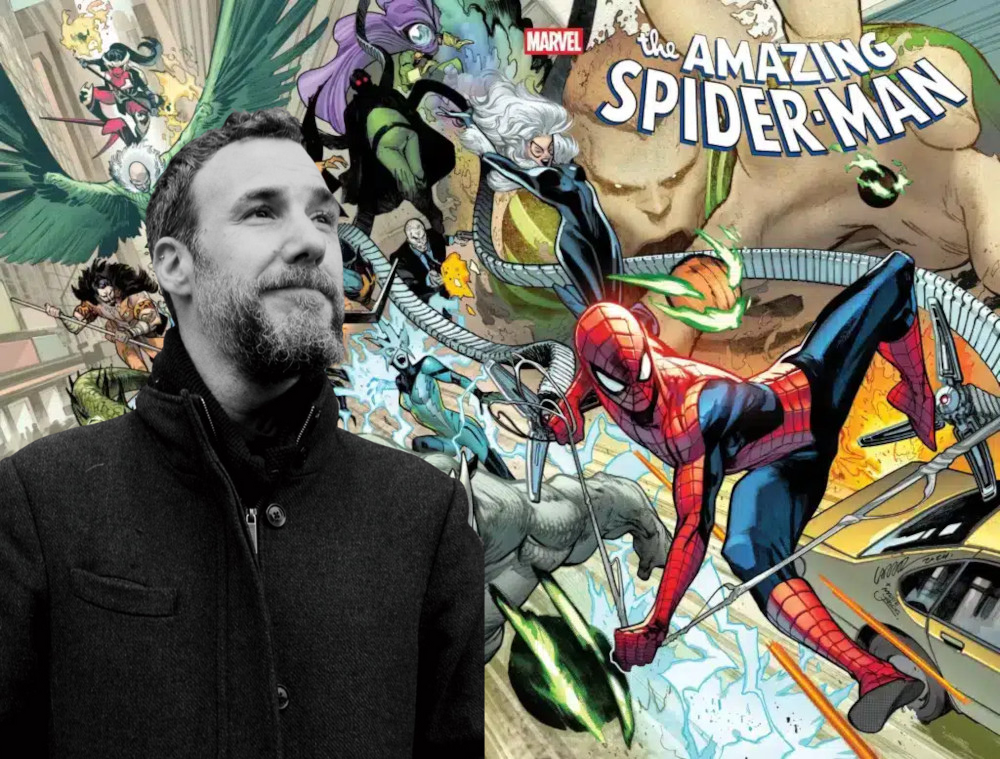
The past few years for Pepe Larraz at Marvel have been anything but quiet: after setting the visual and artistic revolution of the X-Men in motion with House of X, in 2024 he illustrated Bloodhunt, the event miniseries that paved the way for the massive crossover One World Under Doom, which is currently shaking the entire Marvel Universe. But above all, in 2025 he became the leading figure behind the relaunch of The Amazing Spider-Man, written by Joe Kelly. Kelly’s fresh and unconventional approach is elevated by Larraz’s dynamism and expressiveness, as the artist seems to have reached an extraordinary level of artistic maturity and self-awareness while drawing Spider-Man.
During the San Diego Comic Con Malaga, we spoke with him about this exciting new chapter — with a few small spoilers for what’s to come.

Hi Pepe and thanks a lot for your time. You’ve been really busy over the last couple of years, because first you drew a mini-series, Bloodhunt, that was really important — it led directly into the next big crossover, One World Under Doom. And now you’re working on The Amazing Spider-Man. I’d like to start with Bloodhunt — how was it for you to work on this mini-series? It involved a lot of character design for new villains and so on.
It’s funny that you think of it as a mini-series, because it was actually the main road of a very big event — we had a lot of tie-ins and everything. So yeah, I never thought about it as a mini-series, but rather as the main path of the story. But it’s a good way to look at it.
It was great. Jed MacKay was fantastic — his script was so cool, Bloodhunt was a great project. When he first told me “Avengers against vampires,” I raised my eyebrow, it was something curious. But the way Jed MacKay wrote the event was truly interesting. The way he connected all these characters made the threat feel very ominous and very global. That’s exactly how an Avengers story should feel — larger than life. It was very interesting for me to find a way to portray that kind of menace, a world completely in darkness. And it also gave me the opportunity to experiment with visual direction — like making New York completely blacked out. And they were very open to my designs for the vampires, which allowed me to make the book feel more personal. That’s something I always try to do: when I start a new book, I design until the book feels like mine, something I truly want to do. I always joke that I only draw fantasy books — so whatever they give me, Avengers, sci-fi, whatever, I turn it into a fantasy book. And if you don’t believe me, wait until you see what we’re doing in Spider-Man.

And that’s exactly my next question. Speaking of The Amazing Spider-Man, that’s the big thing you’re doing right now. You’ve already worked on several projects connected to the Spider-Man universe, but you’ve never done the main series for a long stretch. How was it for you to get here — and what’s your relationship with the character?
Well, first of all, you have to understand that growing up in Spain, comics — when you discover them as a kid — are mythical. Comics aren’t “made,” they just exist. You find them. You open a magazine or a book and there’s a comic in it, but you never think, “Okay, this was made by a person somewhere.” It just is. It’s a Spider-Man comic and you connect with the character, but not the industry behind it. For me, it always felt so distant — those comics were made far away in America, often years before I got to read them. So it was something remote, something that had happened long ago. Then, when you start working in the industry, Spider-Man still feels like the top of the mountain. You can’t just go to the top of the mountain — you have to climb a lot, it takes time.
So you might have Spider-Man appear briefly in your book — maybe for a couple of issues — but you don’t have Spider-Man. Spider-Man is for the people at the very top, the big names in the industry. So that’s another gap.
And now, even though I’m drawing The Amazing Spider-Man, I still feel that gap — like I’m not worthy of it. Every time I have to draw him, I think that I need to do it better than I’m doing it now. I have to improve — to move him better, to make the poses stronger, to push myself to draw better and bring something new to the character.
I focus on the movement, on how he moves and the sense of speed. That’s what I can bring. I can’t draw better than some of the greats who have drawn Spider-Man — people like Sara Pichelli, Oliver Coipel or Stuart Immonen. So I have to find another space. My space is kinetic movement — maybe I can convey that in a good way.

And it really looks amazing. But another challenge you had to face has to do with the way the story is developing, a way that nobody was really expecting — two Spider-Men, two different settings, one of them in space, one on Earth. Nobody would have imagined Spider-Man there at first. And this also involves a lot of studying different settings and character designs, which for Spider-Man is always tricky, because he’s so iconic. How do you work on the design of a character who’s already perfectly designed?
Well, there’s a romantic answer to that. You have to stay as close to the character as possible — bring something that feels like Spider-Man, keeping the recognizable elements, the eyes, the mask. You’re not going to change that, because it’s Spider-Man. You wouldn’t suddenly make him a hornet or design a suit that let you see his eyes; that wouldn’t make sense. Some things are simply iconic.
So, you focus on the story — on what it’s about — and you design according to that story and to what works best on the page. That’s why I did this design that still feels iconic, but also tells the story: he’s in space, it’s cybernetic, it reflects that context. I don’t like fixed designs — if you look at my work, my designs always move, they evolve.
Yeah, it’s really dynamic.
Exactly. That’s also because I don’t have much memory — I don’t remember my own designs, so I keep changing them all the time! That’s my excuse (laugh). If you want the funny answer, it is that I always wait until the very last moment, because I’m always busy. I have a three-year-old daughter — so I’m constantly busy.So, I wait until the day I absolutely have to do it. That way, there’s no time to overthink — I get an idea and go with it. That saves a lot of time, because if you have a month to do a design, you’ll end up losing time instead.

And since you were talking about the story — how is it to work now with Joe Kelly? Joe already has a long history with Spider-Man at different points in time. How is it for you, to work with him? How’s the collaboration between the two of you?
I still remember the day I found out Joe Kelly was going to be the writer. I was literally on the street, and I almost started dancing! I had just read Immortal Sergeant by him, and he’s a good friend of my good friend, Ken Niimura — so I’d heard about him and his way or work for a long time.
I grew up reading his Deadpool run — it’s amazing. He’s also the creator of Ben 10, which I love! So, yeah, Joe Kelly is incredible. When I learned he’d be writing the series, I was thrilled and deeply moved. The way Joe writes characters really matters — he makes the conflicts human, honest, and real: that’s sometimes the problem with superhero books — the threats are so big that you don’t always feel emotionally involved. It’s just people saving the world, and you may or may not connect. But Joe doesn’t write the hero — he writes the human being inside the suit. And that’s perfect for Spider-Man, because what we truly care about are Peter’s problems. Spider-Man’s problems are reflections of Peter’s problems — amplified, of course, but rooted in his humanity. Joe’s focus on Peter’s inner conflict, the emotions, the struggles — it’s just amazing. I’m really enjoying what he’s doing.
And for you, it’s also nice to work not only on the movements of the heroes but on the acting — the expressions and emotions of the characters.
Yes, it gives you a chance to flex different creative muscles. One of my favorite scenes is a conversation between a very young Peter Parker and Aunt May in a bathroom. Joe wrote it beautifully — I still get goosebumps thinking about it.
It’s such a touching, quiet scene. It gives me a chance to be creative in a different way — not just punch, punch, stab, stab, trip, trip. It’s about silence, acting, finding the exact expression in the exact moment, pacing the page so that it works on an emotional level. It’s a different kind of storytelling — and I love it. But I am also lucky, because at the same time I can write also about giant spaceships, battles, explosions and all that stuff that I love. And you will see, we have so much more for the future.
Thanks Pepe, we look forward to that!
Interview done during the San Diego Comic Con Malaga on the 25th September 2025
Many thanks to the SDCC Press Teamù

Pepe Larraz
José Luis Martínez-Larraz Solís, aka Pepe Larraz, is one of the most outstanding superhero comic writers of his generation. Born and based in Madrid, his bibliography includes his already legendary work on X-Men and the Marvel Comics miniseries House of X.
Trained in sculpture at the School of Arts No. 1 “La Palma” and in art history at the Complutense University, both in Madrid, Pepe Larraz began his career as a fanzine artist and made his debut as a professional comic artist in 2003 with Cristi y sus movidas (Cristi and her issues). Later on he became published regularly in magazines, newspapers and collective projects such as Diez Dedos, Barcelona TM, Cuentos del fin del mundo, Arruequen or Lunático, among others.
In 2010 he made the leap to the US market with New Avengers: Luke Cage. It would be the beginning of a meteoric career at Marvel, followed by acclaimed works in The Avengers, Uncanny Avengers, The Mighty Thor, Wolverine and the X-Men, Star Wars: Kanan and The Last Padawan, among others.
Thanks to these successful works, in 2018 Pepe was selected as one of six artists in Marvel’s Young Guns Program, which highlights the comics industry’s best up-and-coming artists.
Alongside Jonathan Hickman, Pepe has reinvigorated Marvel’s mutant universe with his House of X miniseries. His most recent work includes Big Game, the first Millarworld crossover on Netflix that made history, the Blood Hunt series, the Marvel event of 2024, and since 2025 The Amazing Spiderman together with Joe Kelly.