
Hi Bob, we are happy to be with you on our website. 
Jim Shooter had very strong opinions about how Marvel comics should operate, and how the comics should look. In a business full of creative people, it rubs a lot of people the wrong way when you try to limit their creative freedom with a lot of restrictions and guidelines. I think Jim meant well, but I also think he liked exercising his power. I personally never had any problems with him, and in fact he treated me very well. I think he always tried to give artists as much money as he could, and I considered myself well paid. I know many others didn’t like his management style. So the “atmosphere” at Marvel during his tenure was often tense and a bit stormy. If he didn’t like your work, you were in for trouble. If you didn’t like doing things his way, you were in for trouble. But I think he brought a much needed order to Marvel, and did a lot of good, at least in the early days.
During that period Spider-Man passed through a lot of new experiences… the black outfit, a “dark” period with noir stories but also the wedding… How it was possible they managed to make that “bright” character into a “dark” one and how people reacted?
You’re going to be disappointed in a lot of my answers. I’m an artist, and didn’t pay a lot of attention to that kind of stuff. I concentrated on the jobs I was given, and focused on doing them as well as I could. I liked the characters the way Stan created them for the most part, and didn’t like them getting darker and more violent, more “adult”. But most everyone else seemed to like most of the changes, I think. I know a lot of people didn’t want Peter Parker to get married. I think writers get bored and tired of the status quo, so they want to shake things up and change things. I think they too often try to entertain themselves rather than their audience, and as a result, the audience keeps shrinking.

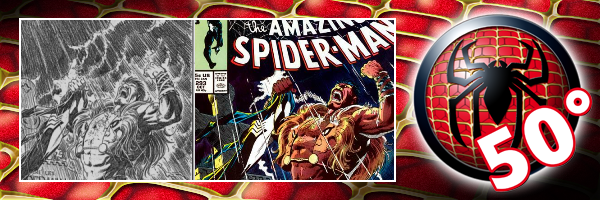
I didn’t read it. I got the tightly penciled covers from Mike Zeck, and thought it looked like a lot of hard work, but it still looked like a project I wanted to be involved with, because it was going to be spread over all of the Spider-Man titles. But I mainly just took the job because Mike asked me to. I had no idea it would be such a phenomenon.

What do you mind about the temporal sequence of events, the fact that Kraven took off Spider-Man identity after he buried him… in a few words the way De Matteis told the story in 6 parts…
Truthfully, that job came along the same time my first child was born, and I was much more interested in her than in comic books. I thought it was a good story, but I wasn’t really reading comics anymore by that point. I was enjoying my baby daughter and didn’t really think about the comic that much. I think because Marvel and DC used to send me a copy of every comic they published, there were so many horrible comics they sent me that I got tired of weeding through them to get to the good ones, and there were a lot of novels I wanted to read, so I just quit reading comics.

Not at all. I had absolutely no idea. For me, this is a job. It’s work. It’s my career. I’m not a fan. It was always about the art for me, not the story. I was fascinated by what an ink line can do. How you can create a picture by making black marks on white paper. That’s what I was interested in.

As I said, I wasn’t paying much attention, really. I don’t remember being aware of the fan reaction until much later. Years later.

The fans were totally unaware that I was contributing as much as I was. Most fans are completely ignorant of what inkers do, and Marvel didn’t even credit inkers as finishers half the time. But fans didn’t know what a “finisher” or “embellisher” was anyway. I worked to satisfy my own high standards, and to impress my peers and the editors who gave me work, not the fans.
Website of Bob Mc Leod: www.bobmcleod.com