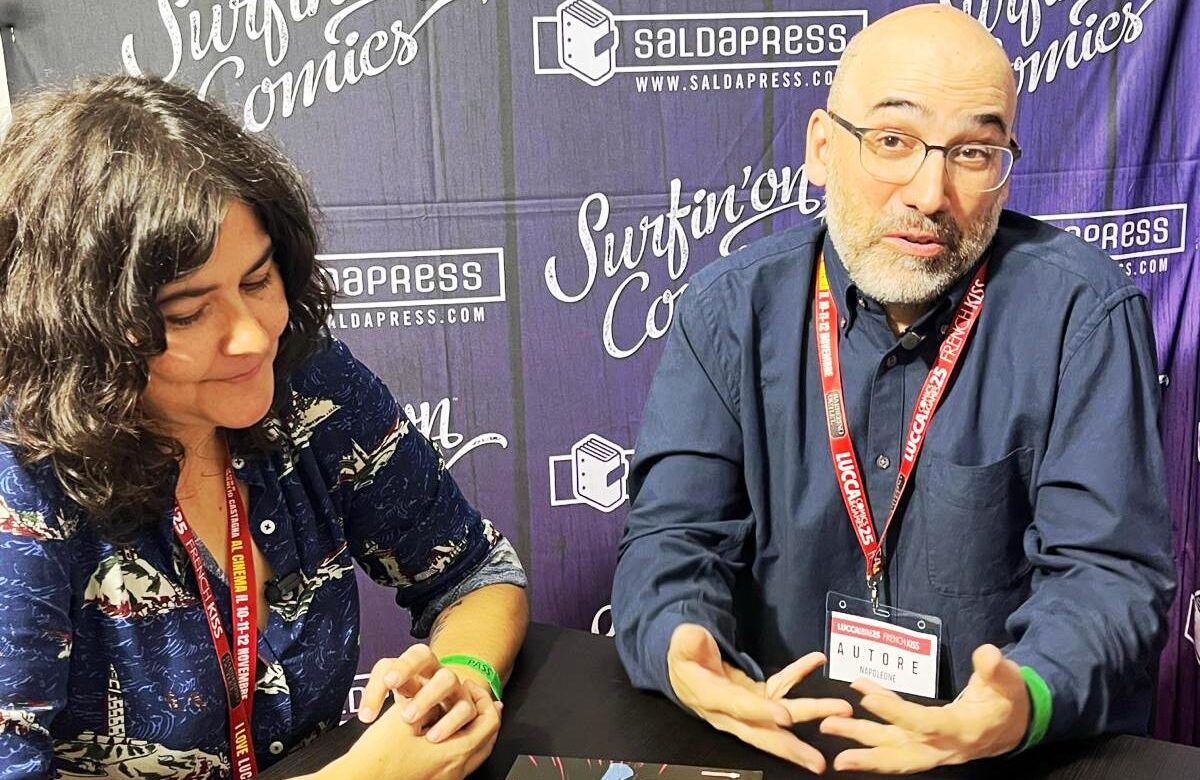
For many years, the pair — partners both in art and in life — formed by illustrator Marcos Martin and colorist Muntsa Vicente have moved between mainstream comics and creator-owned projects, produced in a particularly creative way: together with Brian K. Vaughan, they are the minds behind the Panel Syndicate project, a website where they publish digital comics (their own and those of other creators) offered to readers through a “pay what you want” model, before later releasing them in print with other publishers (mainly Image Comics).
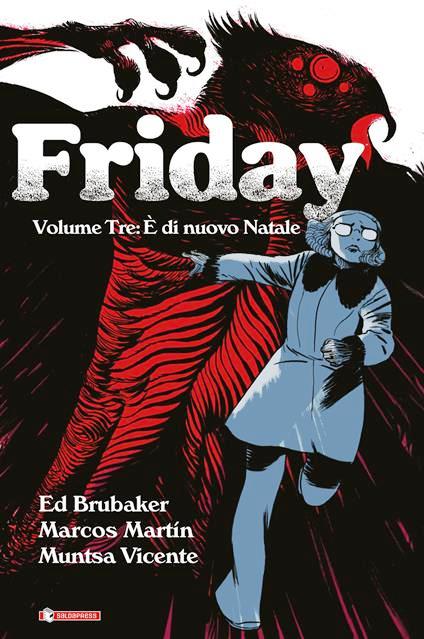
This is precisely how Friday (written by Ed Brubaker and published in Italy by Saldapress), a comic that blends thriller and coming-of-age elements with horror and action, and Barrier (written by Brian K. Vaughan and published in Italy by Bao Publishing), a science-fiction story set along the U.S.–Mexico border, came to life. Very different atmospheres, very different stories, but united by deep character work and, above all, by Martin and Vicente’s versatility, which allows them to create worlds that are distinct yet always evocative.
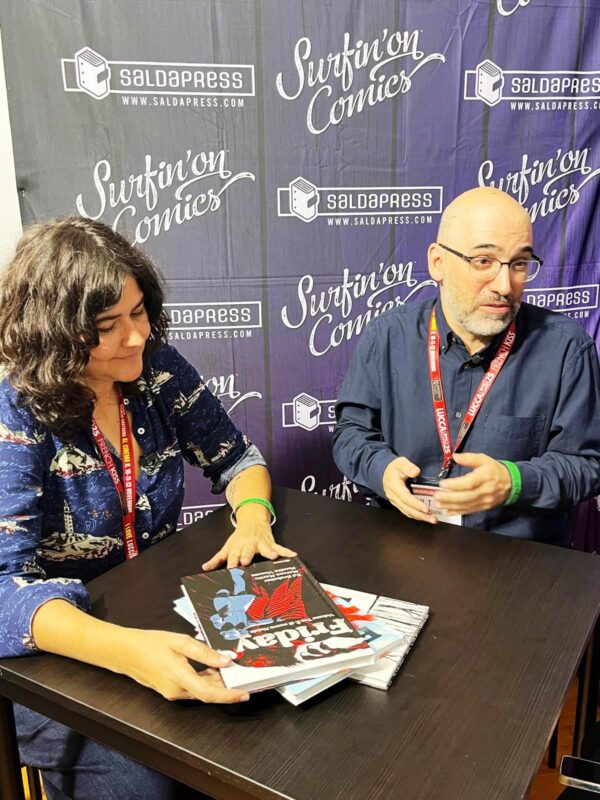
At Lucca Comics & Games 2025 we talked with them about these works and about Panel Syndicate.
In the afterword to Friday, Ed Brubaker writes that you asked him to write something for you and Friday was the result: did you contribute to the plot or is it entirely his work?
Marcos Martin (MM): The story is entirely by Ed, he’s the one who had the idea, and he’d had it for a long time before I contacted him about doing something together. He saw it as an opportunity to finally put into place and into reality a world he’d been thinking about for years. And when he told me about it I knew it was exactly what I was looking for.
I don’t have any real contribution to the plot; my contributions come afterward, in terms of the atmosphere, the characters, all of that.

Friday is a mix of many things—adventure (more or less juvenile), horror, mystery—elements tied together through the script and the artwork. Did you work on balancing these aspects? Was there any inspiration from artists you looked to when building your imaginary?
MM: When we first approached the story, my main interest was to give it a bit of an illustration approach from the ’70s. So I looked at art from that time. I looked at Edward Gorey: he was a clear reference although he’s very far from my style.
I tried to integrate elements of his style, like the cross-hatching and the way he built characters. That’s why, for example, Friday has a square head. I tried to simplify shapes: Lance is like a triangle and Friday is a square. I wanted to give it a children’s-book or illustration-book sensibility, so I looked at anything that would help me build that world with that specific mood and atmosphere.

There’s also a very distinctive work in the coloring, which moves across a wide range of forms. How did you work with your wife—and how did you work with your husband—on these aspects?Muntsa Vicente (MV): Marcos had a very clear idea about the color: not about the palette itself or the tones, but about the way it had to be applied. He wanted something very pictorial, and at first I didn’t think it was a good idea because the drawing is so beautiful and so detailed. I thought that a flat, pictorial color wouldn’t work.So we went back and forth, because he was like—
MM: There were arguments. (both laugh)
MV: My job is basically not to ruin his drawing. I was really worried that a flat or more texturized color would be confusing with the lines and everything. But after a while I got it: “OK, now I know what you want.” And he was totally right. I won’t say it out loud, but he was right. And once I understood, the process became so much easier. It was all about building this world, this atmosphere. It’s a very particular tone: it has a bit of everything, as you said: melancholy but also happiness, it’s about friendship, but it’s also fantasy. Doing it his way made everything much easier than the way I initially imagined.
MM: Also, since I was thinking a lot about the ’70s—because this is Ed revisiting the young-adult books from that era, the kid-investigator stories—one of my ideas for the color was to limit the palette to the amount of colors available in comic books in the ’70s. So, to make Muntsa’s life much harder, I limited the colors to percentages of 25%, 50%, 75%, and 100%.
MV: Basically get rid of grays, all the mid-tones. For shadows you have to come up with different solutions. It was challenging, but I think it worked really well, because you get combinations of colors that maybe you wouldn’t expect but that work very well.
MM: Modern comics have so many color options that sometimes they tend to go too far into realism or into the million colors you can find in nature. I really like the way color was approached in the ’60s, ’70s, ’80s, when they didn’t have the technical means for all this. Those limitations encouraged colorists to come up with solutions that are kind of lost today.
MV: So that’s why we can’t use gradients. It’s all painted (using Photoshop, but still), and so you get rid of all these middle tones and fading.You don’t want any gradients, but just flat colors combined. I think that gives the book a different personality, hopefully.

Compared to The Private Eye, you changed the page layout, essentially abandoning the widescreen format. Was this decision motivated by the possibility of publishing the story, or were there other reasons?
MM: When we did The Private Eye, we had no intention of ever going to print. I designed it to be digital. That’s why we used the widescreen format, as it is the computer-screen format, where it was meant to be read.
But when we started talking about Friday, Ed was adamant that it was going to be published. So from that starting point, I used a regular comic-book format. It’s really an iPad format, which is slightly different from a comic, but essentially the same. The only extra thing we did was create a single-page and a double-page version in case you were reading it on a computer screen, so you would have both.
In the interview we did with you in Rome in 2023, you said that the Panel Syndicate experience was coming to an end. Would you like to say a few words about the project and take stock of it?
MM: No, we are still here, butPanel Syndicate is always kind of in a coma state. Sometimes it wakes up, and sometimes it goes back to sleep. The problem is that the authors don’t get paid until they draw and we release the comic. And they get paid according to whatever the reader decides. So what has been happening is that it’s not profitable for the creators. It’s been profitable for us, but not as much for the other creators who have come in. And I don’t want to keep opening it to other creators knowing they won’t make enough money to support themselves. So that’s why right now it’s a little on hold. It may never be completely dead, but I don’t know when it might come back.
But when it does come back, it will be a surprise. We won’t announce it until the day it comes back to life.
Speaking of Panel Syndicate and the horizontal format—in Lucca you also presented Barrier with Brian K. Vaughan. In this work, you combine science fiction with a topical subject that is becoming increasingly prominent in US and Western politics,like migration. How did you approach this project? And how important or effective do you think it is to address certain issues through comic books?
MM: You know, comics is a medium, and it’s equally capable of tackling political and social issues as any other medium. If you can do it in movies, TV, books, then there’s no difference with comics. So for me it’s not even a question. Sometimes it happens, sometimes comics are more social, sometimes more political, sometimes pure entertainment. But there’s nothing in the comics medium that prevents it from tackling any kind of issue. And I think manga and the Japanese know this perfectly—they have comics about everything.
And would you like to read more comics that talk about what’s happening in politics, or do you think there’s no need?
MM: If they’re good, sure. I’m only looking for good comics, good stories. Whether it’s comics, movies, TV—I don’t mind. But I don’t want to read a bad comic about anything.
MV: Maybe comic books, especially for young readers, are a good way to approach certain issues—like political issues—because it has always been a friendly medium for them. So it’s positive in that way. And we would not make anything too obvious: we don’t want to talk about Trump. No. We make it about us.
MM: But we will try to manipulate the dude through our comics. (both laugh)
Interview conducted at Lucca Comics & Games 2025 on October 31.
Special thanks to the Saldapress team and Rachele Bazoli for their support.
Marcos Martín
After creating covers for Spanish reprints of Marvel comics, Marcos Martín made his U.S. debut with a short story in The Batman Chronicles. He then began a collaboration with DC, for which he illustrated numerous series. In 2006 he moved to Marvel, starting a partnership with Brian K. Vaughan on the Doctor Strange series and illustrating several issues of The Amazing Spider-Man, which earned him an Eisner Award nomination. In 2011 he began illustrating Daredevil; the series won an Eisner Award and received two nominations for “Best Cover” and “Best Penciller/Inker.”
In 2013 he founded Panel Syndicate together with Brian K. Vaughan, a digital platform for webcomics in multiple languages based on the Pay What You Want model, where he published The Private Eye, written by Vaughan. The series, reprinted by Image Comics (and published in 2017 by BAO Publishing), was critically acclaimed and won a 2015 Eisner Award (for “Best Digital/Webcomic”) and a Harvey Award (for “Best Online Comics Work”).
In 2018, again on Panel Syndicate, he reunited with Brian K. Vaughan to illustrate Barrier (2025, BAO Publishing), while Friday, written by Ed Brubaker, followed in 2021 (2025, Saldapress). In 2025 he illustrated several issues of Absolute Batman for DC Comics, written by Scott Snyder.
Muntsa Vicente
Illustrator for Elle Magazine, Harper Collins, and Vitruvio–Leo Burnett, has worked on television commercials and has been involved in merchandising and packaging. In 2005 she made her debut as an illustrator in Curvy2, a volume curated by female designers and illustrators, followed by other editorial projects. In 2012 she began working as a colorist for Marvel on Daredevil, which led to an ongoing collaboration with Marvel and DC that saw her work on Batman, Spider-Man, and other U.S. series. Together with her partner Marcos Martin, she worked on The Private Eye, Barrier, and Friday, all published on the Panel Syndicate platform and later released by Image in the United States and by Bao Publishing and Saldapress in Italy.