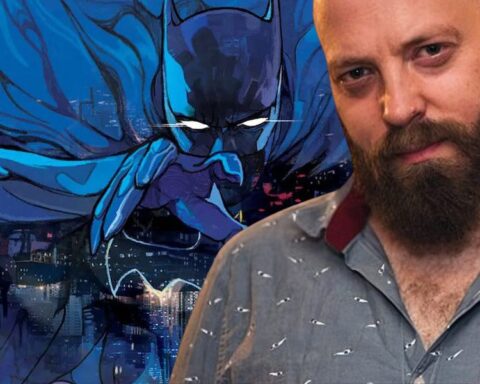
For many years, Matt Fraction has been one of the top superhero writers in the industry: from more indie-like hit titles such as Hawkeye, and mystery pulp books like The Immortal Iron Fist, to blockbuster runs like Iron Man and crossover events like Fear Itself, Fraction helped define the Marvel superhero landscape of the early 2000s. At the same time, he also wrote successful creator-owned comics such as Ody-C (with Christian Ward), Sex Criminals (with Chip Zdarsky), and Casanova.
After some time away from superheroes to focus on the TV series belonging to Legendary Pictures’ Godzilla franchise — Monarch — for which he served as showrunner and co-creator together with Chris Black, Fraction is now back on one of the most iconic superheroes ever: Batman. Together with Jorge Jiménez, he will bring the Dark Knight into new territories (as announced in Málaga, he will face a new and terrible villain, the Minotaur) and explore many different directions.
We met him to talk about his ideas for Batman and the perspective through which he plans to write the character.
Hi Matt, and thanks for your time. You are back to comics with the new Batman series, after working for some time in Hollywood, writing, developing, and co-creating the series Monarch. How was this experience for you, what did you learn, and how was this hiatus from comics?
Well, I never stopped writing comics. Terry and Rachel Dodson and I do a book called Adventure Man that was coming out fairly consistently — just a bit slowly. But it’s true that I very consciously stepped away from monthly comics once Monarch was greenlit.
That’s because working in television is like dealing with floodwater — it fills every moment of your life. Every inch it can get, it’ll consume.
I think it was four or five years between the day I first pitched the show and when our cameras finally rolled, and then still another year before it made it to air. I had worked too long to be an absentee parent, and I figured, maybe I’ll never sell another show, but I want to have this experience — to learn what it means to run a show, to work in a writers’ room, to co-manage this entire enterprise that is Monarch with my partner Chris Black. So I just threw myself into it completely.
In fact, I had several projects lined up, but I cut all my collaborators loose, because I couldn’t do anything else once the show was moving forward. If I don’t write, they don’t draw, and they don’t get paid. For me, it was about acknowledging the monstrous scale — pardon the pun — of television. I was in Vancouver and Japan for 100 of our 106 shooting days. Six months of my life were spent living on set and making Godzilla happen. It was that big.
I didn’t want to divide my attention, because TV takes everything you have to give. After that, I left the show before the writers’ room had even wrapped on season two. There were a lot of reasons, but mostly it felt like I needed something new and exciting.
I didn’t leave knowing that Batman was going to happen. I had no idea what I was going to do. I spent a week convinced I had just destroyed my career. Then Chip Zdarsky — my beautiful Canadian boy — told me he was leaving Batman and asked if maybe I’d be interested. I said yes immediately. I don’t think he wanted to leave, but it was a creative decision for him. And I think he didn’t want to leave his editors high and dry, so he introduced me to DC. I started talking to Rob Levin and Marie Javins at DC, and everything’s been great ever since.
I’ve been working on this book for almost 20 months at this point. The first issue came out on September 3rd, but I’ve been working on it since April 2025.

So now you’re back to superheroes, a genre you’ve already worked a lot on, especially for Marvel Comics. Batman is different in many ways — it carries a different “weight,” so to speak. He’s unique and deeply iconic, probably the most iconic alongside Superman and Spider-Man. How does writing him differ from writing other characters?
I think part of that uniqueness lies in the fact that he’s existed for 85 years. There have been 1,060 consecutive months of human history with Batman stories told across every medium imaginable.
He’s the coolest superhero. He’s got the coolest car. He lives in the coolest town. He has the coolest bad guys, the coolest friends, the coolest hideout. He’s a perfect comic book character for American superhero stories in every possible way.
And personally, Batman was also the first comic I ever read. I was three years old, in the summer of 1978. Batman #316 is the comic that made me fall in love with comics — not just Batman, but comics as a medium.
So what scared me, intrigued me, and felt like a challenge — like a mountain I wanted to climb — was a simple question: Can I write a comic that celebrates that?
Can I write a comic that would have made me fall in love with comics at age three? Not that it’s for children, but can I write a Batman comic that is, first and foremost, a comic book — a superhero comic book? That’s how I approached the character.
As for superheroes in general, they’re all different — and that’s what I love. I’ve had many issues in my life, and I get into trouble when I get bored, so I don’t like repeating myself. That’s why I love cross-training, and that’s why I love superheroes: they let me fight a different bear every day, so to speak.
With Batman, what I wasn’t expecting — what I wasn’t ready for — was his history. He’d been around 30 years before Marvel! I didn’t really understand what 85 years of history felt like. But it’s amazing. There’s tons of Batman material I’ve never read, even though I’ve been reading it since I was three. I love that there’s always more Bat-stuff to discover. And it’s all great — full of things that inspire me, that I love, that I want to learn from.
My approach is informed by that — by centering Batman as a superhero comic book, everything else becomes possible. That archetype is magnetic to every genre. I can do horror, war, western, noir, action — all of it — because at its core, it’s a superhero comic, and it’s never going to feel weird. Superheroes are so malleable, like a binding polymer that holds everything together.
 Speaking of stories from the past, are there any that inspired you? And how does it feel to introduce a new villain — the Minotaur — into a gallery that, as you said, is already the coolest ever? What perspective are you taking to write this?
The most interesting and inspiring thing to me was those first few years of Detective Comics and Batman, when Bill Finger and Jerry Robinson were figuring out what they could do. They were so wildly inventive. It’s like looking at The Beatles’ career and realizing it all happened in just eight years — they went from “Love Me Do” to “Strawberry Fields” in a remarkably short time.
I’ve really gotten a kick out of those early Batman stories, where they were constantly pushing boundaries — figuring out what was too far, too weird, and what really worked. They were inventing a new idiom, the superhero idiom, by borrowing from others — without even knowing it. If you read those stories, you can see what they took from pulp, from German Expressionism, from other genres, and from movies. You can even tell what films were coming out at the time, because their influence shows up immediately in the comics.
Reading these stories as the new Batman writer, I approached them with an archaeological and anthropological eye, trying to see: how long did it take for Batman to really become Batman? When did the lava cool enough that you could finally walk on it, so to speak?
 That’s really interesting to hear. And from there, what direction do you want to develop further?
I think wild invention is the goal — which is crazy. When Tom King wrote Batman, he famously said he wanted to do a hundred issues. I remember thinking, “That’s nuts.” I think I did 68 issues of Iron Man in total, and that was a lot. I still had gas in the tank, but if you’d asked me to do 40 more, I’d have said, “I don’t know.” I thought that kind of ambition was youth, or maybe just madness.
But now that I’m here, I get it. It would be the easiest thing in the world.
I want to focus for a while on doing single-issue stories, and the reason is that I feel like it could all be taken away from me at any moment. I feel like I’m going to get kicked out, so I want to play with all the toys while I can. What if I never get to write the Riddler again? Then I’d better write a Riddler story. I can’t believe I hadn’t gotten to Two-Face yet — what’s wrong with me not writing Two-Face?
It reminds me of when the first Iron Man movie came out. I literally thought, “God, I wish I were writing the Iron Man comic.” And then I realized — “Oh, right, I actually am!” I went home and wrote Iron Man #5 right after, fueled by that energy.
I have that same kind of energy now. I want to do it all — to find all the different modes and ways to tell these stories. Writing short, self-contained stories is really hard. It’s much easier to write one long story and just chop it into pieces. But I don’t like getting bored, so I’ve given myself a difficult and high bar to clear. I hope readers think it works.
You’re working with Jorge Jiménez, who has been a constant presence on Batman over the years, offering different perspectives on the character and becoming one of the most iconic Bat-artists. What does it mean for you to work with someone so flexible and accomplished in interpreting the Dark Knight? How has the collaboration between you two been?
I’ll say it clearly: DC relaunched the book for Jorge. They love and appreciate him. They wanted to give him a huge platform — and I can’t believe I get to work with him.
I have a list in my notebooks of things I think would be amazing to see him draw. I don’t know where they’ll fit, but as a huge fan of his, I’m always thinking, “What if he did this? What if he did that?”
He’s a generational talent, and he’s nowhere near his peak. He gets better with every panel he draws. He’s like a Pokémon that doesn’t stop evolving. Is this his final form? No — he’s got more. He’s an F1 racer that’s not yet in top gear. I’m trying, as someone who loves his work, to write stories that push him — and that inspires me too.
The first time we spoke, DC put us together on a Zoom call — it was like an arranged marriage. One of the first things I said was, “I think I want to put Batman back in the blue and gray.” And Jorge was immediately all in. From that moment on, we found our groove, and now we’re constantly pushing each other.
We’re like hyperactive kids with a box full of markers and a pile of paper — we can’t wait to draw on all of them. He’s the best. And I love him.
Interview done on 2025, october 27th during San Diego Comic Con Malaga
Thanks to the Press Team of the SDCC, especially Paul Ockelford
Matt Fraction
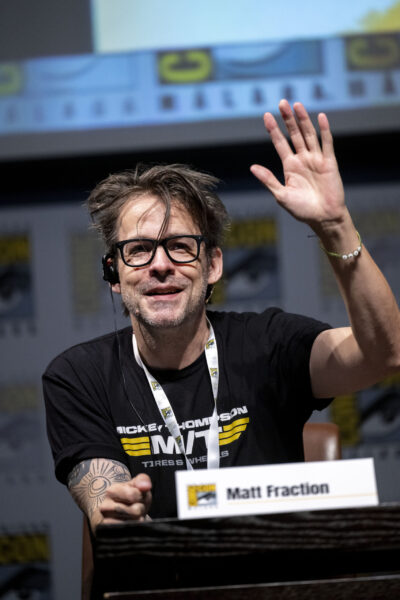 Born in Chicago in 1975, after working in a comic book shop during the 1990s, he began writing creator-owned comics for IDW and Image Comics, including Casanova and The Five Fists of Science. In 2007, he started working for Marvel, co-writing the acclaimed The Immortal Iron Fist with Ed Brubaker. He later went on to create Invincible Iron Man, Thor, Uncanny X-Men, and Fear Itself.
In 2012, together with David Aja, he created a highly acclaimed Hawkeye series, which earned multiple Eisner and Harvey Awards. During the same years, he continued to write creator-owned comics such as ODY-C (with Christian Ward), Sex Criminals (with Chip Zdarsky), and November (with Elsa Charretier).
In 2022, he worked on the TV series Monarch: Legacy of Monsters, part of Legendary Pictures’ Godzilla saga, serving as co-creator and showrunner. In 2025, he returned full-time to comics with the relaunch of Batman, alongside Jorge Jimenez.