I don’t care about Superman. And he doesn’t care if I do. The air, Coca-Cola, traffic-jams and procrastinating cable repairmen are not something it’s necessary to have an opinion on; they will always be there, and most of them were humming along before you were here.
And yet whole sections of the economy, the environment, life itself would cave in if these things weren’t in place. Certainly the citadel of superheroes would have nothing to stand on if not for the original character from whom they take their noun. One doesn’t care about Superman because one doesn’t have to. But that’s just one more job he won’t be thanked for.
Mark Waid is famous for saying that he was inspired to write comics by the calling of learning that there was one symbolic being out there who, whether he even knew Waid, would always care about him. This was Superman, and of course Waid went on to write one of the all-time most-meaningful Superman stories in Kingdom Come (with artist and co-creator Alex Ross).
Not insignificantly, this was as much a story about how the character had strayed from his roots as it was an affirmation of those beginnings. The Kingdom Come Superman is isolated, embittered, and cast off by a world of heroes who have forgotten how to serve society selflessly. They don’t know better and he does, which makes his alienation the true transgression.
 The rehumanizing of superhumans is a prevailing theme of that series, and for a long time Superman has been seen better in reflection than full-on. It seems the essence of Superman is best expressed in stories that avoid his current presence, stories that are off-continuity from whatever his current flagship series is, and thus, in DC’s company perception, “don’t count,” though they’re often the ones that mean the most to both longtime fans and the general public.
We get the essence of Superman’s altruism, his humility, his ability to be bound by nothing but duty, his sense that his specialness is betrayed if he believes that his importance is singular — we get these qualities in stories set in the past, or alternate timelines, or guises that don’t go by his name at all.
 Most people’s favorite “Superman” story of the last 30 years is the Alan Moore run on the kindred archetype Supreme in the late 1990s, which restored the charm and goofy possibility and imaginative vistas of the classic original. Other writers explore what would happen if Superman didn’t care in the way Mark Waid was comforted by, or what toll it would take on humanity if Superman were scarred by our own lack of appreciation for his assumed acts of salvation. The most significant of these is Waid’s own Irredeemable/Incorruptible set of series, in which the rogue ubermensch’s absence of principle showed how precious the archetype of the angelic but grounded Superman could be.
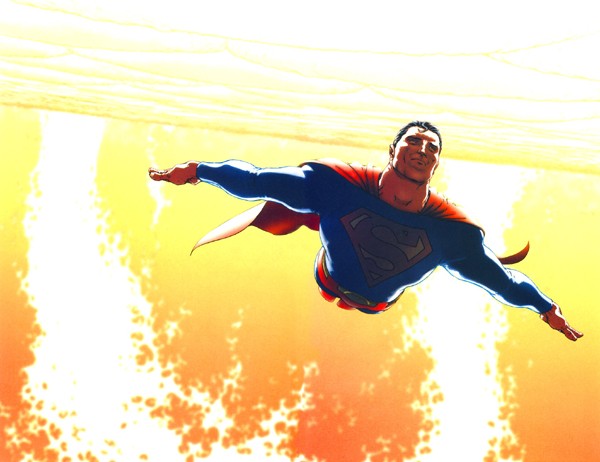
 It’s often said that a hero who can do anything offers no tension in what’s at stake for him, and thus inspires no interest in readers with any sense of real-life decisions and consequences (even allegorical ones). Which is why Superman gets interesting based on what he chooses to do out of all that anything. The goodwill and sacrifice and tenderness he chooses in series like Grant Morrison & Frank Quitely’s All-Star Superman (set in a parallel composite timeline to the series’ several-decade catalogue) and Darwyn Cooke & Tim Sale’s run on Superman Confidential (set in a generalized past) make him interesting; a strongman not necessarily able to uphold humane values in a complex and dangerous world (indeed, universe) where there is lots left to lose.
Those runs were intensely conscious of the accumulated canon of the character, something that was supposedly swept clean with the New 52. DC has miscalculated in that housecleaning, at least where this character is concerned — the public knows, likes and depends on a Superman with red underwear who’s married to Lois Lane and is old as hell and twice as wise; America’s Dad. But a dad who’s eternally boyish, too, which keeps him fresh — like most dads, there are some things he’ll always do better than you can and some things you’ll always know better than he does. When most casual readers, or the general audience — those who read a Superman comic once in a decade or go to a Superman movie once in 20 years or watch the perennial TV series or cartoons — when these observers want continuity wiped, they expect it wiped clean to the fundamentals of the character that have hung on over decades. Marvel’s heroes were built to change, but DC’s were meant to gather history, and that’s why they stand as strong as Robin Hood and Hercules.
The theme of Kal-El as repository of an entire planet’s DNA in Man of Steel was thematically true to these expectations (notwithstanding how wayward from the essence of the character many think that movie is) — no matter how young he’s supposed to be with each resetting of the DC Universe stopwatch, we know he always holds within him each era’s version, like quantum coats of paint. This of course also means that the character has ascended to such archetypal status that each era can have its own Superman figure — opening space for Supreme and Samaritan and Hyperion and The Plutonian, and allowing successive eras to project traits of their own onto (and into) Superman himself — another legitimating factor for Man of Steel’s conception.
 Ironically, the way forward, though, is for the original to fight his way back through these layers and see how his values hold up. In Greg Pak and Jae Lee’s haunting, superb New 52 Batman/Superman comic, we see the first seepage of the previous era’s — and most people’s — version of Superman back into the modern model (the “full” Batman having survived for 13 issues into the New 52 era smuggled inside Morrison’s Batman Incorporated — though that wraps up as Batman/Superman’s second issue hits the shelves, so the latter book can serve as a lifeline for both archetypes). The responsible, measured, authoritative husband of Lois is back in a time-bending arc — and the Man of Yesterday’s Tomorrow may have a message for a future we can all enjoy.